What is Oro?
Oro is a privacy-first gold credit protocol built around two assets:
ZGLD: a confidential Aztec representation of tokenized gold exposure.ORO: a dollar-targeted debt asset minted againstZGLDcollateral.
The first product goal is simple: let users move gold exposure into Aztec, keep their activity confidential, and optionally create ORO against that collateral.
Oro is not trying to make the whole financial stack confidential at once. The current design focuses on a narrow, understandable path: bridge, hold, mint, repay, withdraw, and bridge back.
The Oro testnet build uses mock XAUT (mXAUT) on Ethereum Sepolia and Aztec
5.2.0 contracts. Its complete 5.2.0 redeployment must be finished before the
public app is reopened. It is not a mainnet deployment and must not be used
with real funds.
What you can do
- Bridge supported gold-backed collateral into Aztec.
- Hold or transfer
ZGLDwith privacy. - Deposit
ZGLDinto a collateral position. - Mint
OROwhen the position remains safely collateralized. - Repay
ORO, withdrawZGLD, or exit back to Ethereum.
ZGLD is the confidential gold asset. ORO is the optional debt asset created against it.
Why gold?
Gold is widely understood as a reserve asset. It is liquid, familiar, and historically used as a store of value. Oro uses that familiarity as the collateral base for a privacy-preserving credit system.
The protocol does not claim that gold removes all risk. It gives users a confidential way to hold and use gold-backed value inside Aztec, while keeping debt creation constrained by collateral rules.
Why confidentiality?
Crypto and blockchain systems make financial activity unusually visible. Balances, flows, positions, and habits can become signals for attackers, competitors, or unwanted profiling.
Confidentiality is a security layer. The less unnecessary information a user exposes, the smaller their attack surface becomes.
The strongest secret is often the one that never has to be revealed. Oro uses Aztec so users can act without broadcasting every detail of their gold exposure or credit activity.
The basic idea
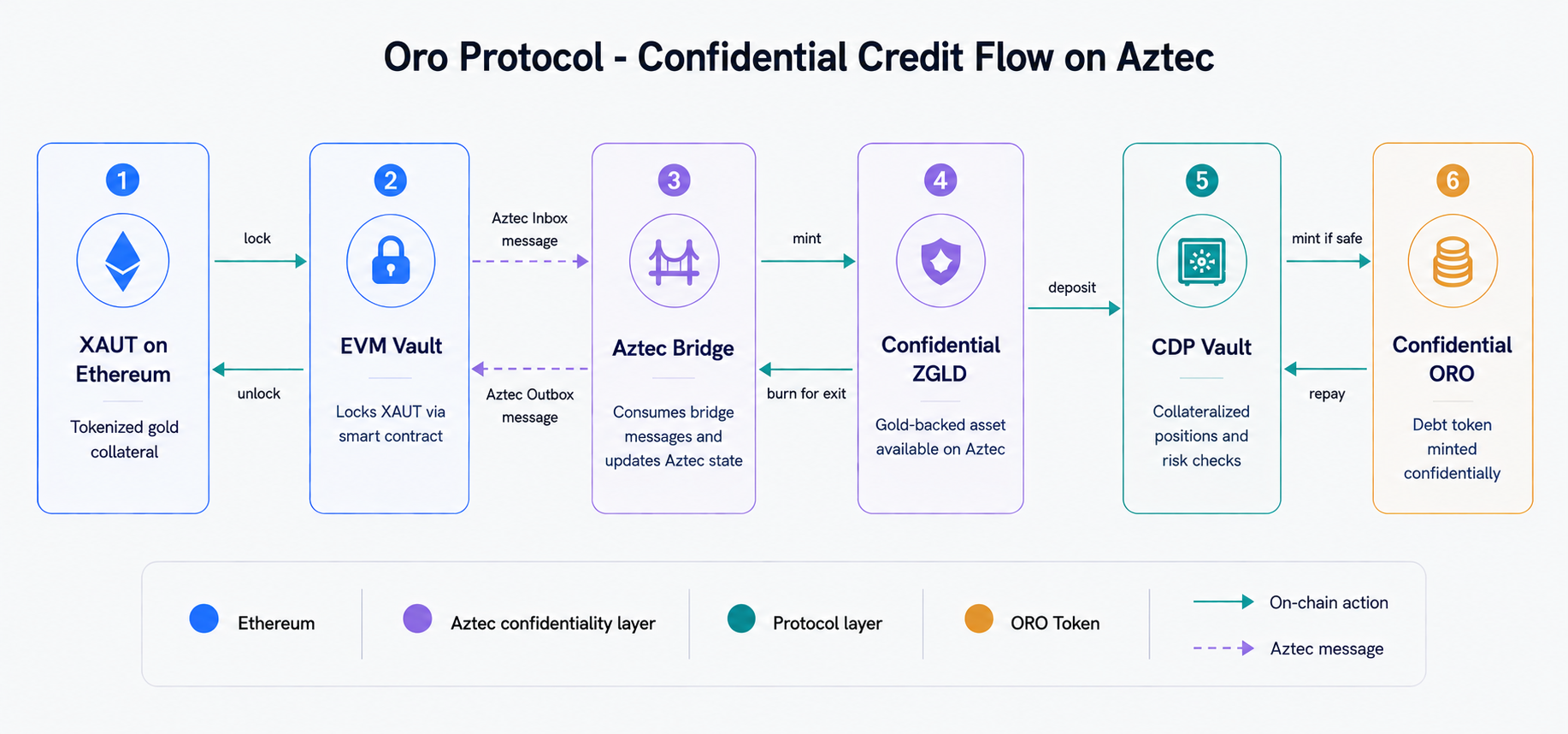
How value and risk are managed
Oro separates value movement from debt creation:
- Bridging creates
ZGLDonly when gold-backed value is accounted for by the bridge flow. - Holding
ZGLDdoes not create debt or liquidation risk. - Minting
OROrequires a collateralized position. - Oracle freshness matters: minting should stop when price data is stale.
- Repayment and withdrawal flows help users reduce or close risk.
This keeps the user model simple: ZGLD is the collateral asset, ORO is the optional debt asset.
What users should remember
ZGLD is the confidential gold-backed asset. ORO is optional debt created against it.
A user can bridge into ZGLD and simply hold or transfer it. Opening a debt position is a separate choice, with separate risk.
The current testnet risk parameters and operational limits are described in Protocol Overview and Risks.